Types of Clamp Meters and Their Uses
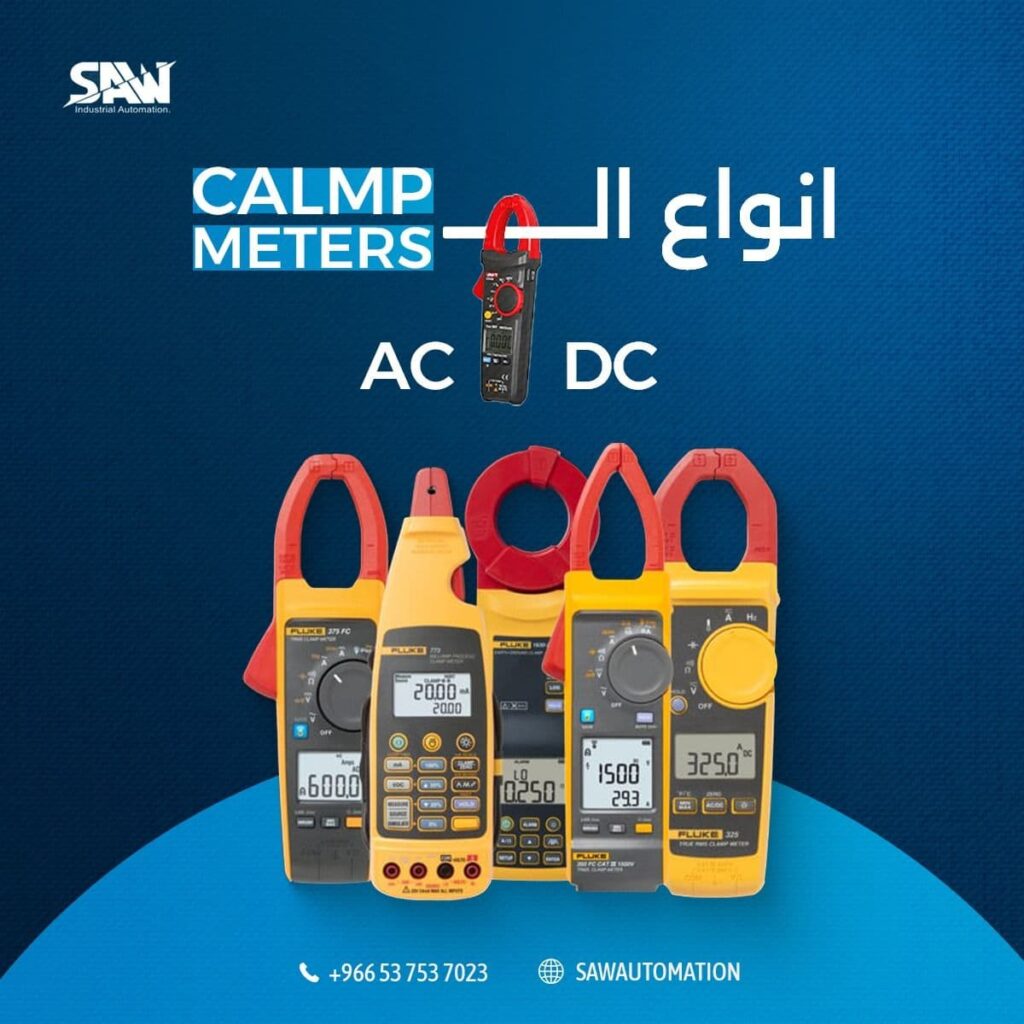
Types of Clamp Meters and Their Uses. The different types of Clamp Meters and their applications are important topics in electrical engineering, as the Clamp Meter has become an essential tool for measuring electrical current safely and quickly without disconnecting the circuit. Consequently, many engineers and technicians rely on it in maintenance work and laboratory testing. With the increasing number of models and features, users often search for how the device works and how to select the most suitable type for their needs.
What Is a Clamp Meter?
A Clamp Meter operates based on the principle of electromagnetic induction to measure current flowing through a conductor without touching the wire or interrupting the circuit. For this reason, it is known as a “current measuring device with a clamp.” Moreover, it provides a much easier user experience compared to a traditional multimeter, which often requires disconnecting the circuit.
Clamp Meters can measure high current levels — sometimes up to 1000 amperes — making them suitable for industrial environments. Additionally, these devices offer several important advantages, including:
- Measuring current without cutting or stripping wires.
- Portability and ease of use across different locations.
- Multiple functions in advanced models, such as voltage, resistance, AC, and DC measurements.
How to Use a Clamp Meter
Using a Clamp Meter requires only a few steps, but accuracy is essential for obtaining reliable readings. To achieve the best performance, follow these steps:
- Turn on the device and select the type of measurement (AC or DC current).
- Open the clamp and place it completely around the wire carrying the current.
- Read the value displayed on the screen or analog indicator, depending on the device type.
For example, if you expect a current of 10 amperes, it is recommended to set the range slightly higher to ensure accurate measurement. However, if no reading appears or the device produces unusual sounds, this may indicate an internal malfunction that requires inspection before continuing use.
Types of Clamp Meters
Clamp Meters have evolved significantly in recent years, resulting in a variety of models suitable for different applications. The most common types include:
1. Analog Clamp Meter
This type is suitable for simple applications, as it uses a moving needle to display readings. Although less accurate than digital models, it is still useful for quick measurements.
2. Digital Clamp Meter
This is the most widely used type in industrial settings due to its clear digital display and high accuracy. In addition, it can measure voltage, resistance, AC current, and DC current.
3. Smart Clamp Meter
This model supports wireless communication technologies such as Bluetooth and Wi-Fi, allowing users to connect the device to a smartphone or computer for easy data analysis.
4. DC Clamp Meter
Widely used in solar energy systems and battery testing, this type provides stable and accurate DC current measurements.
5. AC Clamp Meter
This is the most common type in residential and commercial electrical networks due to the frequent need to measure AC current in wires and devices.
Applications of Clamp Meters
Because of their versatility, Clamp Meters are used in a wide range of electrical applications. Therefore, they are among the most essential tools for diagnostics and maintenance. Key applications include:
- Electrical system maintenance: Measuring loads and detecting faults before they worsen.
- Industrial environments: Inspecting motor currents and equipment performance.
- Solar energy systems: Measuring current output from solar panels and batteries.
- Laboratory testing: Providing accurate readings during scientific experiments.
- HVAC systems: Measuring compressor current during charging and maintenance.
Additionally, technicians rely on Clamp Meters to inspect electric motors and locate faults within circuits, enabling quick and efficient troubleshooting.
Factors to Consider Before Buying a Clamp Meter
To select the most suitable device, it is important to consider several criteria before making a purchase. These include:
- Identifying the type of current to be measured (AC or DC).
- Choosing a device with high accuracy and stable readings.
- Preferring advanced models that support data logging or wireless connectivity.
- Ensuring the device is from a trusted and reputable brand.
- Comparing price and build quality to achieve the best value for money.
For frequent use, it is recommended to choose a high-quality digital model to ensure stable performance under all working conditions.
Conclusion
In conclusion, the Clamp Meter is one of the most essential electrical measuring tools, offering safety, ease of use, and high accuracy without disconnecting wires. With multiple models available, users can select the ideal type depending on whether the application is residential, commercial, or industrial. By following the recommended guidelines, users can obtain accurate readings that enhance system performance and support proper troubleshooting.